 Bungeeexchange
 supports token swaps and perpetual trading
Bungeeexchange uses Socket routing to swap tokens within one blockchain or transfer them between supported chains. Its other products include Terminal for perpetual trading and Bungee Funded Perp for evaluation-based funded accounts. Its swap service combines liquidity discovery with execution, so the selected route determines token compatibility, costs, and settlement requirements. A quote identifies the input asset and intended destination output, while permissions depend on the token and execution method. Available routes can change with liquidity, provider coverage, and the integration used to access them.
Source-chain confirmation does not establish delivery; the route’s completion status identifies when the destination funds have arrived.
Moving an asset into a different network
When the desired asset lives on another supported chain, the service can combine exchange liquidity with cross-chain transfer infrastructure. A swap changes the asset held; bridging moves value between networks. A cross-chain swap may involve both operations, depending on the route. The interface expresses them as an input token and a destination token, without making the underlying functions identical.
Within one chain, exchange liquidity can provide a swap without a cross-chain bridge. Across chains, the liquidity and settlement paths must also cover both networks. This distinction explains why a same-chain quote can exist even when a similar cross-chain request has no available route. Chain support alone does not establish support for every token pair.
Token identity includes the destination network and its contract address or equivalent identifier. Identical symbols can represent different assets or token versions, with different liquidity. The received token must match what the intended wallet or application supports. Changing the destination network changes the available markets and settlement path, even when a token label remains familiar.
Cross-chain routes also introduce a settlement interval. A quoted delivery time estimates the chosen route; it does not impose a common deadline on every bridge. Congestion and provider execution can change the wait. Route comparison therefore involves both the destination amount and the time needed to deliver it.
Socket routing and the shift to a unified API
Socket supplies the routing infrastructure behind the swap service; the app, widget, and API expose it through different interfaces. The team introduced Bungee, previously named FundMovr, in March 2022. Its routing engine connects liquidity sources with execution and settlement paths. An intent specifies a desired outcome, with the infrastructure coordinating fulfilment under the applicable route conditions.
Auto and Manual in Bungee API v1
In the legacy Bungee API v1, Auto and Manual described different execution paths. Auto supported signed Permit2 transfers for ERC-20 tokens, the common token standard on Ethereum-compatible networks. Native-token Auto transfers used the Bungee Inbox contract; ERC-20 tokens could also use that path when Permit2 was unsuitable. Manual exposed multiple route choices and separate transaction construction, with token approvals where required.
Socket Swap V3 execution
Socket Swap V3 returns a unified route array for same-chain and cross-chain quotes. Connected-wallet routes supply transaction data for direct on-chain submission. That flow differs from API v1’s Permit2-based Auto method, which submitted a signed request through the API. V3 also supports deposit-address funding, with a refund address required.
A deposit preview requiring activation does not yet provide funding instructions. Activation must produce the usable deposit details before the transfer can proceed.
Wallet permissions and the intended recipient
The input token and execution method determine the required wallet permissions, while the recipient identifies where the route should deliver its output.
ERC-20 allowances and transfer signatures
An ERC-20 allowance lets a specific contract spend the approved token on the wallet’s behalf. It concerns the named spender and amount; it does not authorize every asset in the account. Permit2-based legacy Auto transfers add a signed authorization with an amount and expiry. The token’s underlying allowance and that transfer signature are separate permissions.
Native inputs and recipient addresses
Native-token inputs do not use ERC-20 allowances. A wallet may still need a source-chain transaction and the native balance its execution requires. The receiving address is part of the quote and may differ from the sending wallet. The destination network and asset remain part of that delivery instruction.
Permission checks for a connected-wallet quote
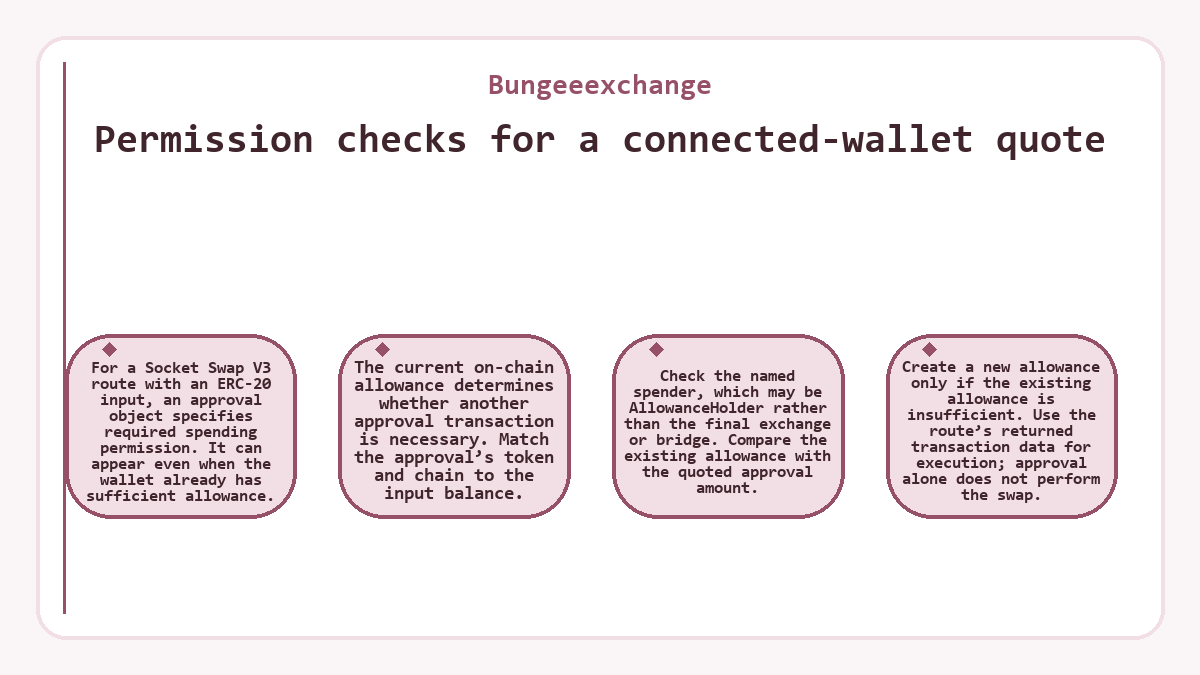
For a Socket Swap V3 route with an ERC-20 input, an approval object specifies required spending permission. It can appear even when the wallet already has sufficient allowance. The current on-chain allowance determines whether another approval transaction is necessary.
- Match the approval’s token and chain to the input balance.
- Check the named spender, which may be AllowanceHolder rather than the final exchange or bridge.
- Compare the existing allowance with the quoted approval amount.
- Create a new allowance only if the existing allowance is insufficient.
- Use the route’s returned transaction data for execution; approval alone does not perform the swap.
What costs affect the amount received?
Network execution, provider charges, and any integrator fee determine a swap’s effective cost. Legacy Bungee Auto included on-chain execution costs within its quoted fees. Socket Swap V3 supports integrator fees and reports client-facing output net of those fees. A new token approval can add a separately payable source-chain gas cost. Compare output after fees and any separately payable gas cost for the same input amount. A gasless signing step does not establish cost-free settlement.
What does Incognito change about wallet privacy?
Incognito is designed to separate the sending wallet from the receiving wallet in the route’s user-facing transaction path. In Socket Swap V3, it selects privacy-capable providers rather than the full bridge and exchange marketplace. This concerns a direct wallet link, not a claim that all blockchain activity disappears. Provider handling and the supported route still determine the scope of the transfer.
Within Swap V3, the mode supports connected-wallet transaction routes on eligible Ethereum Virtual Machine (EVM) networks and Solana. It requires a refund address and allows same-chain, same-token transfers. Deposit-address and exchange-withdrawal flows do not support this mode. Incognito is also incompatible with expected-output and exact-output quotes.
Quotes, settlement, and destination delivery
A quote and an origin transaction describe earlier states than destination delivery. In Socket Swap V3, COMPLETED means the destination funds have been delivered. PENDING identifies a route which has not started, while IN_PROGRESS means execution remains underway. A source-chain confirmation can therefore coexist with an unfinished cross-chain transfer.
A REFUNDED status reports a refund, while FAILED reports a failed or cancelled route. EXPIRED reports an expired quote or execution window. Deposit flows may also report REFUNDING, REFUND_FAILED, or MANUAL_REVIEW_REQUIRED. These states require handling beyond a completed-or-pending display. A refund in progress does not establish that the funds have already returned.
Access through the swap app and other Bungee products
The swap app, an embedded interface, and a direct API integration offer different ways to access routing.
Embedded swaps and custom integrations
Socket Widget provides a React interface for swaps and bridging, while a direct API integration handles the product’s own quoting and transaction flow. In widget version 1.0.0, the host app supplies wallet connection state and compatible network adapters. The widget handles routing and transaction interactions using those adapters. A host can restrict available chains and tokens, so an embedded integration’s coverage may be narrower than the underlying routing engine’s coverage.
Perpetual trading and funded accounts
The broader Bungee lineup also includes Terminal and Bungee Funded Perp. Terminal offers perpetual contracts referencing supported crypto assets, stocks, and commodities. Bungee Funded Perp requires traders to pass a one-step evaluation before accessing funded accounts for isolated-margin perpetual trading. Passing requires meeting the plan’s profit target without breaching its risk rules. Its trader relationship is a trading mandate: Bungee may simulate, hedge, or externally execute submitted trades. The trader does not own or control the underlying capital. Enabled markets, loss limits, and the account ledger govern these accounts separately from token swaps.
Bungeeexchange: the short answers
Do Bungeeexchange swap integrations always require an API key?
Socket Swap V3 access depends on the endpoint an integration uses. The public endpoint allows unauthenticated testing. Frontend access uses a whitelisted domain and an affiliate identifier, while dedicated production backend access requires an API key and affiliate identifier. Ordinary wallet-based swapping does not require the person making the swap to obtain developer credentials.
How long does a Socket Swap V3 quote remain usable?
A Socket Swap V3 route supplies its own expiresAt value. That expiry applies to the returned quote, so there is no single validity period to assume for every route. An integration should discard an expired quote and request a replacement rather than treat its earlier price or transaction data as indefinitely usable.
Does a completed swap cancel any remaining token approval?
A swap can leave an unspent ERC-20 allowance in place. That remaining permission lets the named spender transfer the approved token within the unused limit. Changing or revoking the allowance updates that permission. A Permit2 transfer signature has a separate scope and lifetime from the token-level approval, so completion alone does not establish that every underlying permission has ended.
Can I specify the destination amount instead of fixing the input?
Socket Swap V3 offers output-based quoting on eligible direct transaction providers. EXPECTED_OUTPUT targets a destination amount while estimating the required input; EXACT_OUTPUT requires the specified output amount for successful execution. These modes require outputAmount instead of inputAmount. They are incompatible with Incognito, and their availability does not establish support in every app or embedded interface.
Does a cross-chain swap include gas for later destination transactions?
A destination token balance does not necessarily include the native token required for later transaction fees. Socket Refuel can add destination-chain gas tokens to a supported route alongside the requested output asset. Its availability depends on route and chain support. A normal token output and a native gas top-up therefore describe separate parts of the received funds.
Is token delivery enough to confirm a destination contract action?
Socket Swap V3 tracks destination delivery and requested contract execution as distinct signals. When a destination payload forms part of the quote, isDestPayloadExecuted reports whether its calldata ran successfully. Funds can arrive even if that execution fails. Payloads require a compatible executor and supported connected-wallet route; deposit-address routes and Sui destinations do not support them.
How are fees calculated for Bungee Funded Perp positions?
Bungee Funded Perp rulebook v0.4, dated October 3, 2026, sets execution fees at 1.5 basis points (0.015%) of executed notional. The fee applies to both maker and taker executions when opening and closing a position. Funding charges are separate, and the dashboard determines the fee actually applied to an account. This schedule concerns funded perpetual accounts, not token-swap routes.